

The Oura ring for labs.
See sample trackingThe result has a record. The journey should too.
Sample-linked record
Storage. Handling. Measurement.
A smart collar in development to connect each sample’s identity, temperature and handling history. Optical measurements are the next research step. Start with one non-clinical laboratory workflow and prove the measurement.
Our workflow goal
Fewer steps.
Not another task.
Laboratory samples move between storage, benches and instruments. Arka is being developed to connect that journey to the lab’s existing records.
Fit the existing workflow.
Evaluate a collar with the lab’s existing vials, racks and inventory system. Integration is planned, not connected today.
Capture once.
Explore automatic event capture through readers or robot integration. Reduce duplicate entries where the workflow supports it.
Focus review on exceptions.
Bring sample identity, recorded conditions and source evidence into the same investigation. Leave missing information visible.
Design goals, not demonstrated outcomes. Manual work, fit, event accuracy and integration requirements must be evaluated in a specific lab workflow.


Were all the samples received?
Three tubes were sent. One was recorded at the lab. Two still need a receiving record; that does not mean they are confirmed lost.
Fictional sample records
No sensor or laboratory connection.
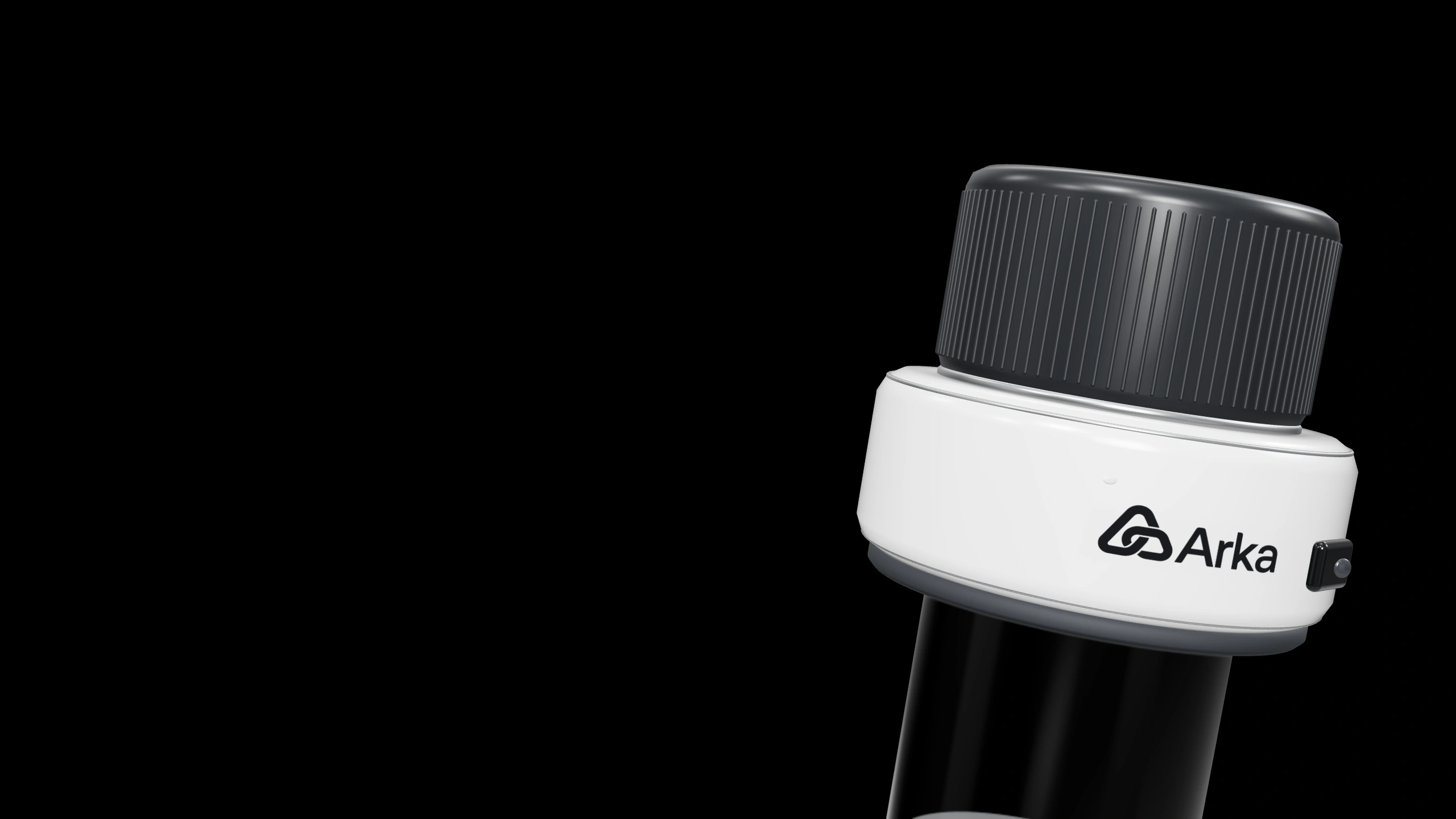
02 / The collar
A continuous shell.
An optical interface.
An identifier that travels with the tube.
Industrial-design study. Materials and components are illustrative.
Industrial-design concept.
Original V5 engineering files remain separate.
One form. Several open engineering questions.
The housing, optical window, carrier and antenna show an industrial-design direction. Their appearance does not establish sensor performance, manufacturability or analytical performance.
Inside the collar
Every component.
A defined job.
The PCB connects the system. The sensors collect signals. A useful analytical result requires a defined method and validation.
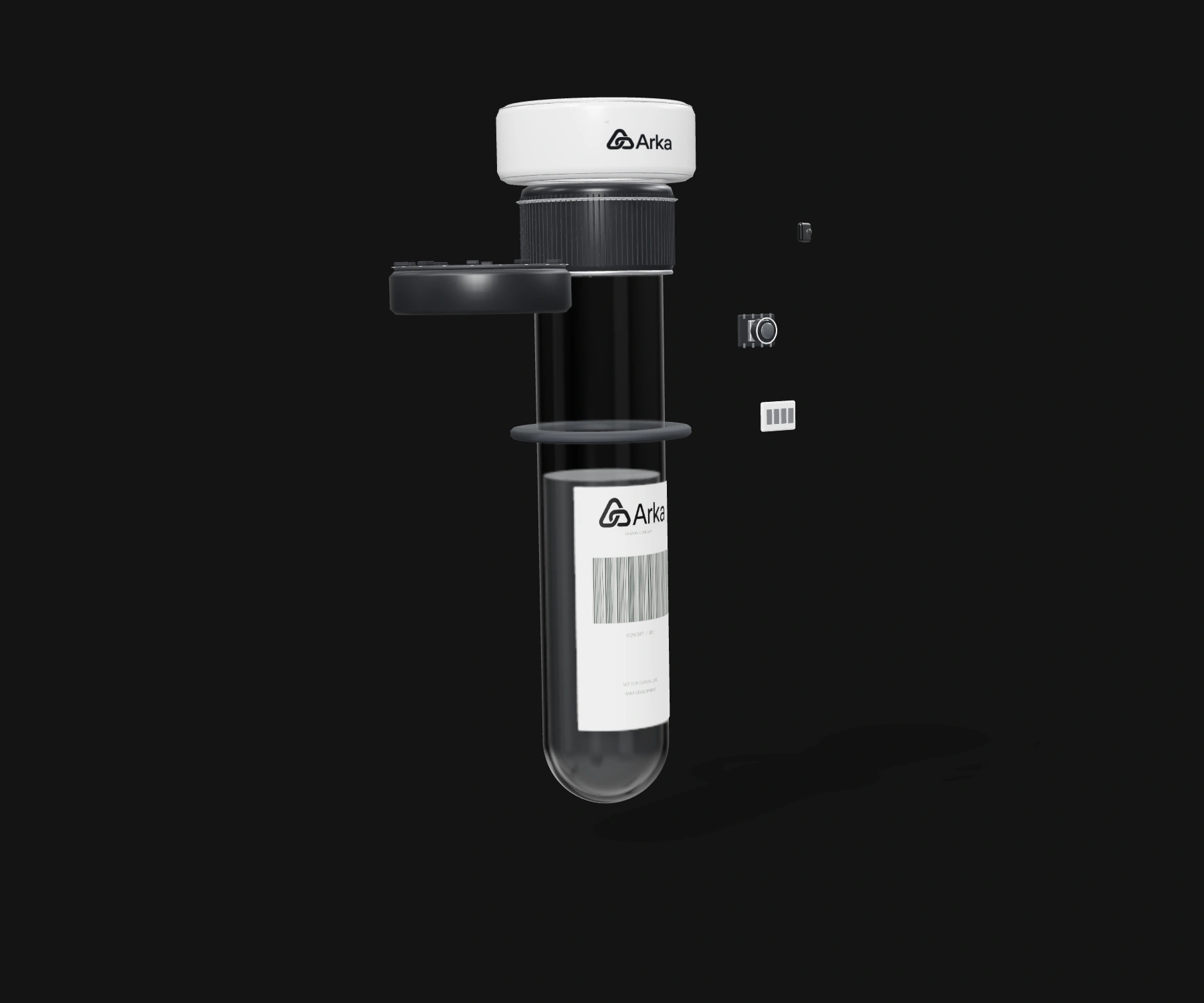 Form study / not component placement
Not a placement drawing or verified pinout.
Signal paths are schematic. NFC is independent. The rendered collar does not establish board routing, component fit or manufacturing readiness.
Integrated board: proposed
Printed circuit board
The electrical foundation
A PCB holds components and connects them with copper tracks. It routes power, ground and signals; the board itself does not analyze a sample.
- Input
- Power and signals from the attached modules.
- Output
- Electrical connections between sensors, controller and interfaces.
What it does not establish
The ring-shaped board in the render is illustrative. V5 uses a controller board and separate sensor modules, not a verified integrated collar PCB.
A signal needs context. Sensor data describes the device's observations. An analytical result requires reference-method agreement.
The measurement plan03 / The research
Laboratory tracking and optical measurement are connected development questions. Select a sample, define the output, agree a reference method and test whether the collar can deliver it. Published research supports the investigation; it does not establish Arka performance.
One sample. One useful measurement.
Evaluate a small-molecule or formulation workflow against an agreed reference method.
Select the sample
Agree the sample, solvent, container and the output the laboratory needs.
Control the light
Fix illumination and optical geometry. Account for vial walls, labels, bubbles and condensation.
Measure repeatedly
Compare optical readings with blanks and repeated reference measurements.
Agree acceptance
Measure error, interference and drift before testing the collar form factor.
A change in light does not, by itself, identify a compound or measure solubility. Sensor selection and performance remain to be demonstrated.
Storage conditions can affect compound quality.
Amgen researchers evaluated 25 selected compounds over 18 weeks. Effects depended on the compound and conditions.
Eschelbach et al., 2011Local exposure can leave a missing record.
Johns Hopkins researchers developed indicator tubes that retain evidence of warming near stored samples.
Catterson et al., 2025Published research, not Arka validation. Exposure does not automatically mean damage.
Laboratory monitoring / In development
Start with your lab.
Tell us what you store, how it moves and what you need to know. We’re looking for a specific workflow to evaluate together.